

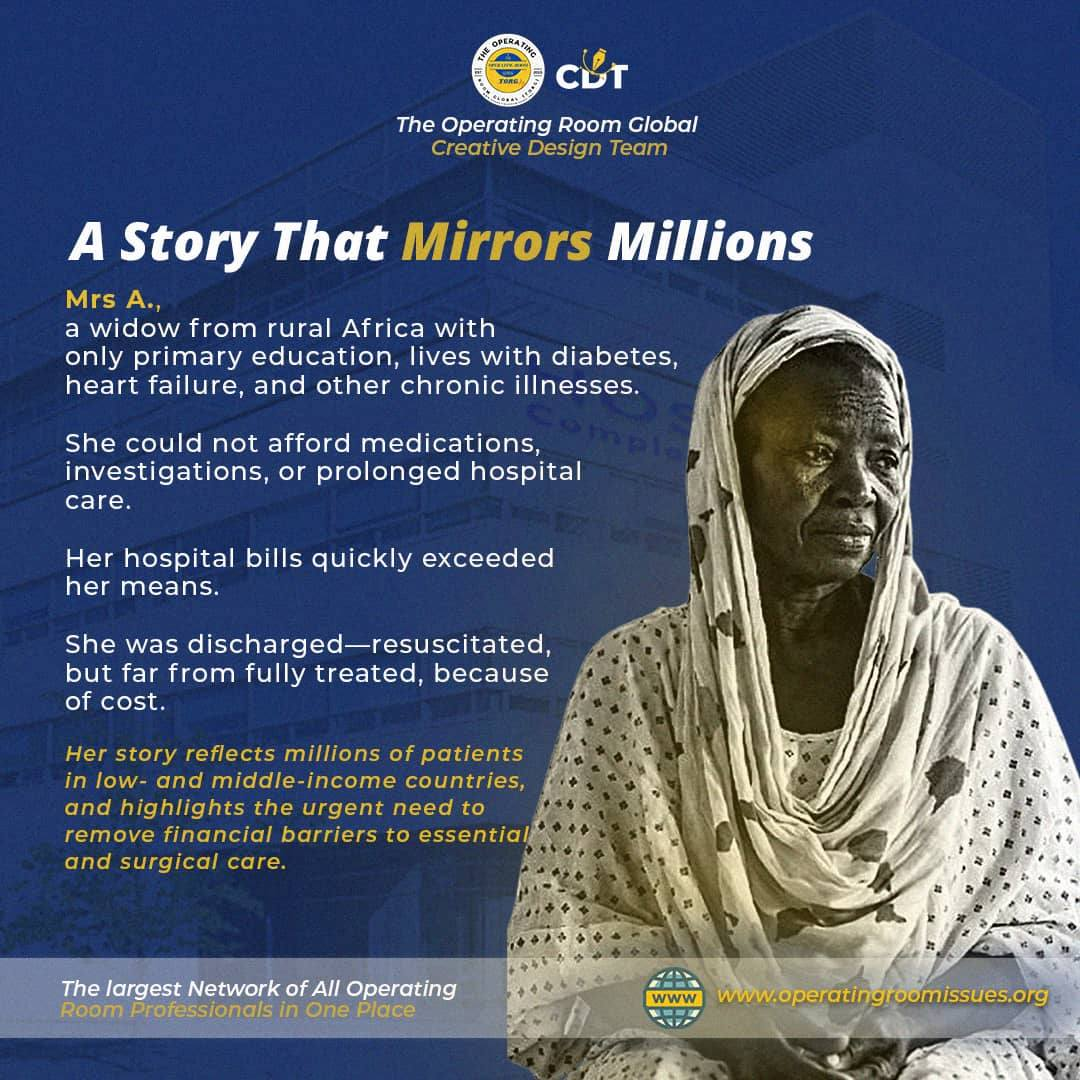
𝗖𝗢𝗦𝗧 𝗕𝗔𝗥𝗥𝗜𝗘𝗥𝗦 𝗧𝗢 𝗦𝗨𝗥𝗚𝗜𝗖𝗔𝗟 𝗖𝗔𝗥𝗘 – 𝗜𝗡𝗦𝗣𝗜𝗥𝗔𝗧𝗜𝗢𝗡 𝗙𝗥𝗢𝗠 𝗧𝗥𝗨𝗘-𝗟𝗜𝗙𝗘 𝗦𝗧𝗢𝗥𝗜𝗘𝗦
𝗔 𝗦𝘁𝗼𝗿𝘆 𝗧𝗵𝗮𝘁 𝗠𝗶𝗿𝗿𝗼𝗿𝘀 𝗠𝗶𝗹𝗹𝗶𝗼𝗻𝘀
Mrs A. is a woman living somewhere in rural Africa. She is a widow with only primary-level education, surviving day by day on what little she can earn or receive. On a fateful day, she was rushed to the hospital in a critical state. She presented with diabetic ketoacidosis following years of poorly controlled type 2 diabetes. Her condition was complicated by severe ascites, bilateral pitting oedema up to the mid-thigh, decompensated heart failure with severe hypertension, and features of advanced diabetic complications, including grade 4 diabetic foot and diabetic nephropathy.
Mrs A. had lived with these illnesses for years, not because they were not manageable, but because they were unaffordable. On presentation, she had no mobile phone, no written contacts, and no family member immediately reachable. Hospital bills for admission, daily meals, bed space, and consultations accumulated. She could not even pay for investigations, medications, or prolonged hospital care.
Healthcare workers, medical students, and kind individuals made contributions so she could receive a few essential medications. However, many of the expensive and most effective medications were beyond her reach. As the days passed, she was finally discharged, but she could not pay her bills to leave, yet she could not pay to be fully treated. She had to stay longer after discharge; each additional night on the ward increased her debt (bed space).
She was discharged after achieving a relatively stable and resuscitated state, but far from optimal care. Not because she was well, but because the system, her caregivers, and she herself had reached a point of collective frustration and helplessness.
This is majorly a medical case (surgical as well though), yes. But Mrs A. is not an isolated story.
She exists in every corner of the global health system, most profoundly in low- and middle-income countries (LMICs).
Yes, I would agree with you that something must be done.

𝗕𝗲𝘆𝗼𝗻𝗱 𝗢𝗻𝗲 𝗣𝗮𝘁𝗶𝗲𝗻𝘁: 𝗔 𝗚𝗹𝗼𝗯𝗮𝗹 𝗦𝘂𝗿𝗴𝗶𝗰𝗮𝗹 𝗥𝗲𝗮𝗹𝗶𝘁𝘆
Mrs A.’s story reflects a wider structural failure in access to healthcare, particularly surgical and perioperative care. Across the world, an estimated 160 million people each year are unable to receive essential surgical care, largely due to financial barriers, weak health systems, and poor policy prioritisation (Nepogodiev et al., 2025).
For many patients, the cost of care is not limited to surgery itself. It includes transportation, investigations, medications, prolonged hospital stays, and lost income. These cumulative costs push individuals and families into catastrophic health expenditure, deepening cycles of poverty and illness. Some would rather die than truncate their children’s future by spending their entire fortune on illness.
𝚂𝚞𝚛𝚐𝚎𝚛𝚢, 𝚘𝚏𝚝𝚎𝚗 𝚙𝚎𝚛𝚌𝚎𝚒𝚟𝚎𝚍 𝚊𝚜 𝚎𝚡𝚙𝚎𝚗𝚜𝚒𝚟𝚎 𝚊𝚗𝚍 𝚜𝚙𝚎𝚌𝚒𝚊𝚕𝚒𝚣𝚎𝚍, 𝚒𝚜 𝚏𝚛𝚎𝚚𝚞𝚎𝚗𝚝𝚕𝚢 𝚎𝚡𝚌𝚕𝚞𝚍𝚎𝚍 𝚏𝚛𝚘𝚖 𝚞𝚗𝚒𝚟𝚎𝚛𝚜𝚊𝚕 𝚑𝚎𝚊𝚕𝚝𝚑 𝚌𝚘𝚟𝚎𝚛𝚊𝚐𝚎 𝚏𝚛𝚊𝚖𝚎𝚠𝚘𝚛𝚔𝚜 𝚒𝚗 𝙻𝙼𝙸𝙲𝚜. Yet without affordable surgical care, conditions that are preventable or treatable become disabling, fatal, or a death sentence .
𝗥𝗲𝘁𝗵𝗶𝗻𝗸𝗶𝗻𝗴 𝗦𝗼𝗹𝘂𝘁𝗶𝗼𝗻𝘀: 𝗣𝗼𝗹𝗶𝗰𝘆, 𝗦𝘆𝘀𝘁𝗲𝗺𝘀, 𝗮𝗻𝗱 𝗜𝗻𝗻𝗼𝘃𝗮𝘁𝗶𝗼𝗻
Addressing cost barriers to surgical care requires more than goodwill or ad hoc donations. It demands 𝐢𝐧𝐭𝐞𝐧𝐬𝐢𝐨𝐧𝐚𝐥 𝐠𝐨𝐯𝐞𝐫𝐧𝐦𝐞𝐧𝐭 𝐚𝐜𝐭𝐢𝐨𝐧 𝐚𝐧𝐝 𝐬𝐭𝐫𝐨𝐧𝐠 𝐡𝐞𝐚𝐥𝐭𝐡𝐜𝐚𝐫𝐞 𝐩𝐨𝐥𝐢𝐜𝐲 𝐟𝐫𝐚𝐦𝐞𝐰𝐨𝐫𝐤𝐬. National surgical, obstetric, and anaesthesia plans (NSOAPs), integration of surgery into universal health coverage schemes, and sustainable financing mechanisms are critical steps toward ensuring that patients like Mrs A. are not denied care because of poverty.
Equally important is the generation and use of reliable data. Understanding who is left behind, why they are excluded, and where system bottlenecks exist is essential to reversing the statistic of 160 million people without access to essential surgery each year.

𝗜𝗻𝗻𝗼𝘃𝗮𝘁𝗶𝘃𝗲 𝗖𝗮𝗿𝗲 𝗠𝗼𝗱𝗲𝗹𝘀: 𝗟𝗲𝘀𝘀𝗼𝗻𝘀 𝗳𝗿𝗼𝗺 𝗔𝗺𝗯𝘂𝗹𝗮𝘁𝗼𝗿𝘆 𝗦𝘂𝗿𝗴𝗶𝗰𝗮𝗹 𝗖𝗲𝗻𝘁𝗿𝗲𝘀
Encouragingly, innovative models are emerging. 𝐒𝐭𝐚𝐧𝐝𝐚𝐥𝐨𝐧𝐞 𝐚𝐦𝐛𝐮𝐥𝐚𝐭𝐨𝐫𝐲 𝐬𝐮𝐫𝐠𝐢𝐜𝐚𝐥 𝐜𝐞𝐧𝐭𝐫𝐞𝐬 have shown promise in reducing cost barriers by delivering essential surgical services efficiently and affordably. In countries such as Uganda, these centres demonstrate how tailored surgical delivery models can lower out-of-pocket expenditure, reduce hospital stay durations, and improve access for underserved populations (Tusiime et al., 2025).
By focusing on high-volume, essential procedures, streamlined staffing, and cost-conscious infrastructure, ambulatory centres provide a scalable approach to improving surgical equity, particularly in resource-limited settings.
𝗔𝗰𝘁𝗶𝗼𝗻 𝗗𝗲𝗰𝗹𝗮𝗿𝗮𝘁𝗶𝗼𝗻𝘀
• Essential surgical care is not a luxury; it is a fundamental component of universal health coverage.
• No patient should be discharged prematurely or denied optimal care due to inability to pay.
• Governments must prioritise surgical care financing within national health policies.
• Innovative, context-appropriate delivery models must be supported, studied, and scaled.
• Data-driven advocacy is critical to exposing inequities and driving reform.
𝐓𝐡𝐞 𝐎𝐩𝐞𝐫𝐚𝐭𝐢𝐧𝐠 𝐑𝐨𝐨𝐦 𝐆𝐥𝐨𝐛𝐚𝐥 (𝐓𝐎𝐑𝐆) stands for advocacy, innovation, and equity in surgical care. We amplify real stories like that of Mrs A. to remind the world that behind every statistic is a human life. 𝐓𝐎𝐑𝐆 is committed to promoting policies, partnerships, and practical solutions that ensure safe, affordable, and accessible surgical care for all, regardless of geography or income.
Mrs A. should not be the norm.
And together, we must ensure that she no longer is.
𝐉𝐨𝐢𝐧 𝐎𝐮𝐫 𝐆𝐥𝐨𝐛𝐚𝐥 𝐂𝐨𝐦𝐦𝐮𝐧𝐢𝐭𝐲!
The Operating Room Global (TORG)
𝑇ℎ𝑒 𝐿𝑎𝑟𝑔𝑒𝑠𝑡 𝑁𝑒𝑡𝑤𝑜𝑟𝑘 𝑜𝑓 𝑎𝑙𝑙 𝑂𝑝𝑒𝑟𝑎𝑡𝑖𝑛𝑔 𝑅𝑜𝑜𝑚 𝑃𝑟𝑜𝑓𝑒𝑠𝑠𝑖𝑜𝑛𝑎𝑙𝑠 𝑖𝑛 𝑂𝑛𝑒 𝑃𝑙𝑎𝑐𝑒!
https://linktr.ee/operatingroomissues
#TORG #theoperatingroomglobal #operatingroomissues #GlobalSurgery #SurgicalEquity #HealthForAll #AffordableCare