

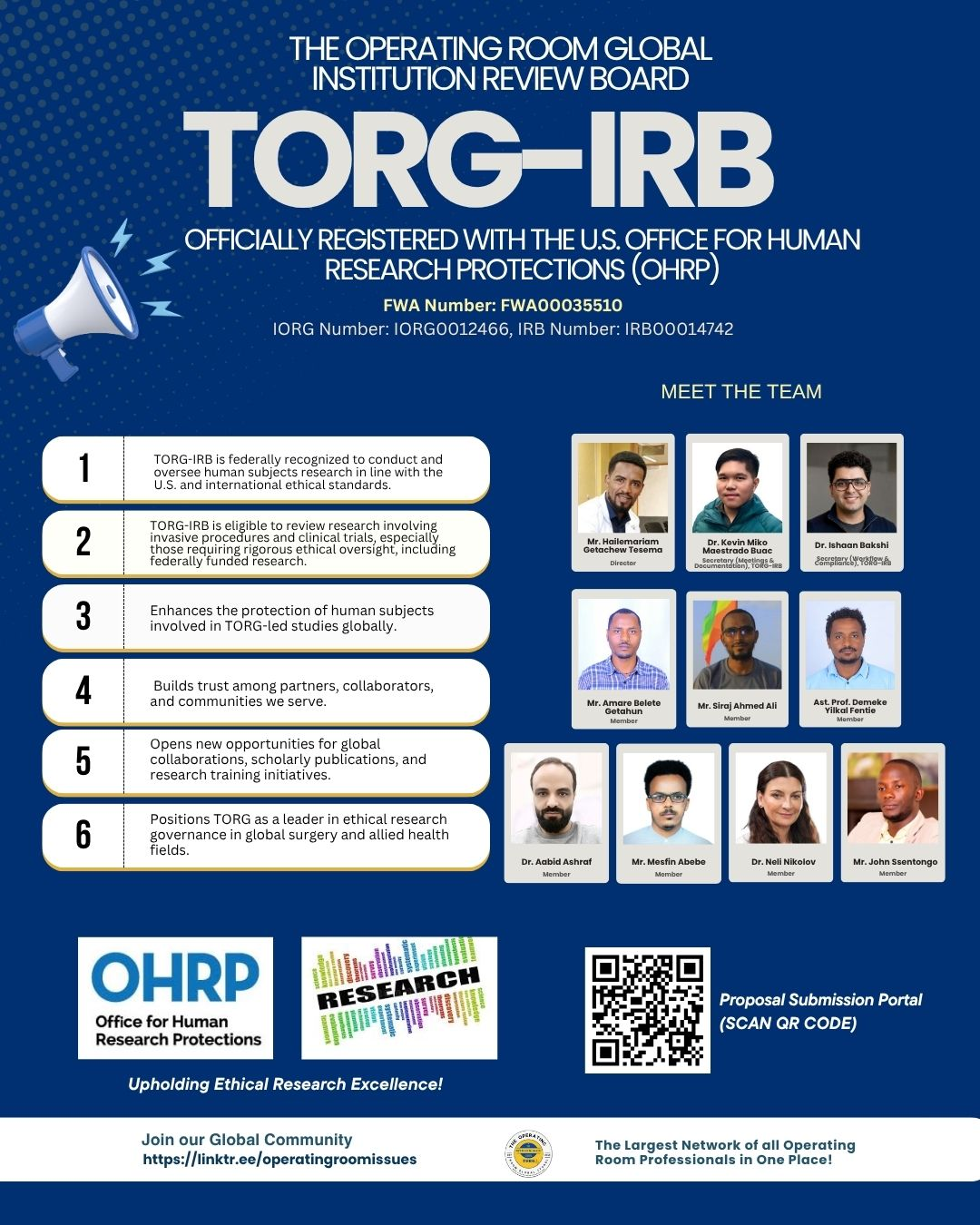
The Operating Room Global Institutional Review Board.
Independent ethical review and oversight supporting responsible, scientifically sound and ethically appropriate research involving human participants, health data and related research materials.
The Operating Room Global Institutional Review Board (TORG-IRB) safeguards participant rights, dignity, safety and welfare while supporting high-quality research across surgical, perioperative, clinical, educational, public-health and allied-health settings.
Supporting ethical research governance across the wider TORG academic, research and collaborative ecosystem.
Independent oversight. Participant protection.
TORG-IRB operates through a structured ethical-review framework designed to protect research participants and support responsible research conduct across eligible studies.
Institutional Organization Registration
Institutional Review Board Registration
Federalwide Assurance
Protect participants · strengthen ethical conduct · support responsible research · promote accountability
Ethical Oversight Before Research Begins.
The Operating Room Global Institutional Review Board (TORG-IRB) is an independent body established to support ethical, responsible and accountable research conducted under The Operating Room Global and its affiliated partnerships.
Research involving human participants, identifiable data or other relevant ethical considerations must receive appropriate approval before the research begins.
Protecting people while supporting meaningful research.
Ethical review is not simply an administrative step. It provides independent consideration of whether proposed research respects participant rights, minimises avoidable risk, manages consent appropriately and is designed to be conducted responsibly.
Respecting autonomy, privacy and informed participation.
Considering foreseeable risks, burdens and participant safety.
Supporting scientifically and ethically responsible research.
Ensuring researchers remain responsible throughout the study.
Research that may fall under TORG-IRB oversight.
The Board considers eligible research connected to The Operating Room Global, its programmes, members, fellows, collaborators and institutional partnerships.
TORG-Led Research
Studies led by TORG leaders, members or research teams operating through recognised TORG programmes.
Fellowship Research
Research undertaken through the TORG Global Research Fellowship and other eligible academic programmes.
Multisite & Multinational Studies
Collaborative projects involving multiple hospitals, institutions, countries or TORG chapters.
Partner-Led Research
Eligible studies conducted through formal collaboration between TORG and partner institutions or organisations.
Vulnerable Populations
Research requiring additional ethical attention because of participant vulnerability or contextual risk.
Human Participants & Identifiable Data
Research involving people, identifiable health information or other data requiring ethical consideration.
TORG-IRB approval does not automatically replace local requirements.
Depending on the country, institution and study design, investigators may also need approval, permission or governance clearance from participating hospitals, universities, local ethics committees, research offices, data controllers or other competent authorities.
Before recruitment, data collection or research activity begins.
Prospective ethical review should be obtained before commencing research activities requiring approval. Investigators should allow sufficient time for administrative screening, ethical review and any revisions requested by the Board.
Research ethics within The Operating Room Global ecosystem.
TORG-IRB supports responsible research within the wider TORG academic environment. Learn more about the academic, research and innovation Centre or explore the parent global professional organisation.
Different Studies Require Different Levels of Review.
TORG-IRB reviews applications under one of four pathways: Exempt Review, Expedited Review, Full Board Review or Administrative Review.
The appropriate category is determined by the IRB after considering the study design, participant population, level of risk, data involved and applicable ethical requirements.
Investigators do not need to determine the final review category themselves.
Submit the complete study through the official TORG-IRB portal. Following administrative screening, the IRB will determine the appropriate review pathway based on the characteristics of the proposed research.
Exempt Review
Certain research activities may qualify for an exempt determination where they fall within recognised low-risk categories and meet the applicable ethical and regulatory criteria.
MAY INCLUDE, WHERE ELIGIBLE“Exempt” does not mean that investigators may simply proceed without submitting to TORG-IRB. The exemption determination should be made by the IRB.
Expedited Review
An expedited pathway may be appropriate for eligible studies involving no more than the level of risk permitted under the applicable review framework and meeting the required criteria.
MAY INCLUDE, WHERE ELIGIBLEExpedited review does not mean automatic approval or reduced ethical standards. The study remains subject to appropriate ethical assessment.
Full Board Review
Studies requiring broader ethical consideration may be referred for review by the convened Board, particularly where participant risk, vulnerability or study complexity warrants fuller review.
MAY INCLUDEFull Board studies may require meeting scheduling, detailed revisions or additional documentation before a final decision is issued.
Administrative Review
Administrative review may apply to submissions or requests that principally require verification, documentation, classification or other IRB administrative action rather than a new full ethical assessment.
MAY INCLUDE, WHERE APPLICABLEThe Board may redirect a submission to another review category where ethical review is required.
Classification considers more than the study design alone.
TORG-IRB considers the overall ethical profile of the study before determining the appropriate review pathway.
Submit early enough to allow for review and revision.
Applications should be submitted at least 15 days before the intended study start date. The standard review timeline is approximately 14–21 days, depending on the level of review required and whether revisions are necessary.
Before the intended research start date
Depending on category and completeness
Your application moves through a structured review pathway.
Application received through the official portal.
Administrative review for completeness.
Appropriate review category determined.
Study assessed through the applicable pathway.
Formal written outcome issued.
You do not need to select the final review category before applying.
Prepare the required study documents and submit the complete application through the official TORG-IRB online portal.
Complete Documentation. One Official Submission Route.
A complete submission helps the Board understand the proposed research, assess its ethical considerations and determine the appropriate review pathway.
Applicants should prepare all relevant documents before opening the official submission portal and ensure that uploaded materials are complete, consistent and current.
All IRB applications must be submitted through the online portal.
Research proposals should not be submitted to the IRB by email. The online portal provides the formal route for application tracking, documentation and administrative processing.
Prepare the documents relevant to your study.
Requirements vary according to study design. Where a document does not apply to your project, this should be clear from the information provided in the application.
Full Research Proposal
Submit a complete study protocol describing the research question, objectives, methodology and relevant ethical considerations.
Cover Letter to TORG-IRB
Provide a formal cover letter introducing the study and summarising the proposed protocol for the Board.
Participant Information & Consent
Studies involving participant consent should include the materials that will be used to inform participants and document consent.
Data Collection Tools
Submit the instruments that will be used to obtain or record study information.
Institutional / Site Permission
Where research will be conducted within a hospital, university or other institution, provide the relevant supporting or permission documentation where available.
Review Protocol & Search Strategy
Systematic reviews and meta-analyses should include the review protocol and planned search strategy as part of the submission package.
Check that your documents tell one consistent story.
The study title, objectives, sample, methods, consent process, data tools and study dates should align across the documents submitted to the Board.
Upload all documents relevant to the study.
Check that study information matches across files.
Submit the latest version of every document.
Ensure uploaded files are clear and appropriately labelled.
A straightforward online application process.
Finalise your research proposal and supporting documents.
Access the official TORG-IRB online application form.
Provide the requested investigator and study information.
Attach the required study materials within the portal.
Send the complete application for administrative screening.
Email is for general enquiries — not IRB submissions.
Applications sent directly by email will be redirected to the online portal so that the study can be properly recorded, tracked and processed.
Ready to submit your research application?
Ensure your application and supporting documents are complete before opening the online form.
What Happens After Ethical Review?
Following ethical review, the investigator receives a formal written outcome from TORG-IRB. The decision may permit the study to proceed, require changes, defer a final decision, or determine that the study cannot be approved in its current form.
Investigators should follow the instructions contained in the official decision correspondence and should not begin research activities requiring approval until the relevant approval has been issued.
Approved
The Board has determined that the study may proceed within the scope, documents and conditions described in the approval.
Approved With Minor Revisions
The ethical basis of the study is acceptable, but limited changes or clarifications are required before final approval or activation.
Major Revisions Required
Significant ethical, methodological or documentation issues require correction before the Board can issue approval.
Deferred
The Board is not yet able to make a final determination and requires additional information, clarification or further review.
Disapproved
The Board has determined that the study cannot be approved as submitted because the identified ethical concerns are not adequately resolved.
Make it easy for reviewers to see what changed.
When revisions are requested, investigators should respond systematically and ensure that the revised protocol and all related study documents remain consistent.
Address each issue raised in the decision correspondence.
Update the protocol, consent materials and tools where required.
Make sure related information matches across all study documents.
Clearly indicate how each requested issue has been addressed.
An approval applies to the study reviewed by the Board.
Investigators should conduct the research according to the approved protocol, approved participant materials, approved study tools and any conditions specified in the IRB decision. Significant changes should not be implemented without appropriate prior IRB review, except where immediate action is necessary to protect participants.
Ethical oversight continues beyond the approval letter.
Review the approval letter and conditions.
Begin only after all required approvals are in place.
Follow the approved protocol throughout the study.
Seek review for amendments and report relevant events.
Complete the required closure or final reporting process.
Preparing a study for ethical review?
Review the requirements on this page, prepare your supporting documents and use the official TORG-IRB portal to submit.
Ethical Responsibility Continues Throughout the Study.
TORG-IRB approval is not the end of the ethical-review process. Investigators remain responsible for conducting the research according to the approved protocol and for communicating relevant changes, safety concerns and study status to the Board.
Requirements after approval may vary according to the study, approval conditions and level of ongoing oversight required.
Follow the Approved Protocol
Conduct the study according to the protocol, procedures, participant materials and conditions reviewed by TORG-IRB.
Submit Amendments
Proposed changes to an approved study should be submitted for appropriate IRB review before implementation, unless immediate action is required to protect participants.
Report Safety Concerns
Relevant adverse events, unexpected problems or participant-safety concerns should be reported to the Board as required.
Continuing Review
Where continuing oversight is required, investigators should submit the necessary progress information before the approval period expires.
Protect Research Data
Maintain appropriate confidentiality, privacy, secure data handling and access controls throughout the study.
Close the Study Properly
Investigators should complete any required final or closure reporting when research activity and participant involvement have concluded.
Changes should be reviewed before they are introduced.
An approved study should remain consistent with what the Board reviewed. Where investigators need to change important aspects of the project, the amendment should be submitted for review before implementation.
Matters that may require communication with TORG-IRB.
Events or circumstances that materially affect participant safety or alter the ethical profile of the study.
Significant departures from approved study procedures, particularly where participant welfare may be affected.
New information that may change the assessment of study risks, benefits or participant protections.
Significant changes to the continuation or operational status of the approved study.
Maintain oversight from approval to closeout.
Depending on the study, the Board may require progress updates, continuing review, amendment review or final study reporting.
Significant protocol changes should normally receive prior review.
The exception is where an immediate change is necessary to eliminate an apparent hazard or protect participant safety. Such circumstances should then be communicated to the IRB as appropriate.
A multidisciplinary Institutional Review Board.
TORG-IRB brings together professionals with varied clinical, academic, research and ethical perspectives to support balanced, independent and responsible consideration of submitted studies.

After uploading the image to the WordPress Media Library, copy the image URL and replace the placeholder URL in the <img> tag immediately above.
TORG-IRB sits within a wider global academic ecosystem.
Learn more about the academic, research and innovation Centre or explore The Operating Room Global and its wider international professional community.
Preparing a study for TORG-IRB review?
Review the submission requirements on this page and submit the complete application through the official online portal.
Principles That Guide Responsible Research.
TORG-IRB evaluates research through recognised ethical principles that emphasise respect for persons, scientific integrity, fairness, proportionality, participant welfare and responsible governance.
The specific standards applicable to a study depend on its design, setting, participant population, regulatory environment and level of risk.
Ethical review balances scientific value with participant protection.
A study should not only ask an important question. It should also be designed and conducted in a way that respects participants, manages foreseeable risk and supports trustworthy research.
Recognising autonomy, dignity, privacy and the right to make informed decisions about research participation.
Seeking meaningful benefit while reducing avoidable risk, burden and harm.
Supporting fair participant selection and equitable distribution of research burdens and potential benefits.
Ensuring that research questions, methods and analysis are sufficiently rigorous to justify participant involvement.
International principles may inform review where applicable.
TORG-IRB considers internationally recognised research-ethics standards alongside relevant local, national and institutional requirements.
Declaration of Helsinki
Ethical principles for medical research involving human participants, including research using identifiable human material or data.
Belmont Principles
Respect for persons, beneficence and justice as foundational principles for ethical human-subjects research.
CIOMS Guidance
International ethical guidance addressing health-related research involving humans, including research in diverse global and resource-variable settings.
Good Clinical Practice
Relevant GCP principles may apply to clinical research involving interventions, investigational products or regulated clinical-study environments.
Some participants may require enhanced ethical safeguards.
Vulnerability depends on context and may relate to age, capacity, dependency, illness, social circumstances, institutional setting or unequal power relationships.
Ethical research includes responsible data governance.
Research plans should explain what data will be collected, why it is needed, who will have access, how it will be stored and how participant confidentiality will be protected.
Collect only information necessary for the research purpose.
Protect research data against inappropriate access, loss or disclosure.
Limit identifiable information to authorised members of the study team.
Define how long research records will be retained and how they will eventually be archived or securely disposed of.
Ethical conduct extends beyond participant consent.
Investigators are expected to conduct and report research truthfully, transparently and in accordance with accepted standards of responsible scholarship.
Relevant relationships should be disclosed and appropriately managed.
Financial, professional, institutional or other interests that could reasonably influence—or appear to influence—the design, conduct, review or reporting of research should be transparently declared.
Ethical review does not operate in isolation from local law and governance.
Investigators remain responsible for identifying and complying with applicable national regulations, institutional policies, professional requirements, data-protection obligations and local site permissions.
Explore the Centre and the parent organisation.
TORG-IRB supports ethical research within the wider academic, research and professional ecosystem of The Operating Room Global.
Preparing research involving human participants or health data?
Review the requirements on this page, prepare the appropriate supporting documents and submit through the official TORG-IRB portal.
Supporting Responsible Research Across the TORG Community and Beyond.
The Operating Room Global Institutional Review Board (TORG-IRB) supports ethical review within the wider TORG research ecosystem while also considering eligible applications from external researchers, institutions, partners and funded studies.
Access arrangements depend on the applicant’s relationship with TORG, the nature and complexity of the proposed research, institutional context, funding status and the level of review required.
Supporting research development within the TORG community.
TORG-IRB provides ethical review without a review fee for eligible active members of The Operating Room Global (TORG) and for actively serving TORG leaders during their current period of appointment or service.
Membership or active leadership status must be current and verifiable at the time the research application is submitted.
Eligible research applications may access TORG-IRB ethical review without a review fee while membership remains active.
Ethical review is provided without a review fee during the individual’s active period of appointment or service with TORG.
This access supports TORG’s wider commitment to ethical research, scholarship, mentorship and academic development.
Membership or leadership status does not influence the ethical criteria applied or the decision of the Board.
Non-member, partner, institutional and funded applications are considered on a case-by-case basis.
TORG-IRB may consider eligible submissions from non-members, collaborating researchers, healthcare institutions, universities, partner organisations and other external investigators where the proposed research falls within the scope and capacity of the Board.
Applications involving grants, sponsorship, institutional funding, commercial funding or other funded research arrangements are also considered individually.
Any applicable review arrangement will be determined after considering the nature, scope, complexity, institutional context, funding status and ethical-review requirements of the proposed study.
Applications may be considered individually where the proposed study falls within TORG-IRB’s scope and capacity.
Review arrangements may reflect the specific partnership, collaborative framework and nature of the proposed research.
Eligible applications from hospitals, universities, research centres and other institutions may be considered.
Grant-funded, sponsored or otherwise funded studies are considered on a case-by-case basis.
External, partner and funded submissions are assessed individually.
TORG-IRB does not publish a universal review arrangement for non-members, partner organisations, institutions or funded studies. Where an administrative or review arrangement applies, this will be communicated directly in relation to the specific application.
Access arrangements never determine the ethical outcome.
All eligible applications considered by TORG-IRB are assessed according to appropriate ethical principles, scientific considerations, participant-protection requirements and responsible research standards, irrespective of membership, leadership, partnership or funding status.
Submit directly or contact TORG-IRB first.
The appropriate route depends on your relationship with TORG and the nature of the proposed study.
Ready with a complete research application?
Review the submission requirements on this page, prepare the required supporting documents and proceed through the official TORG-IRB online submission portal.
Submit IRB Application ↗Contact TORG-IRB regarding review arrangements.
Briefly describe your proposed research, institution, investigators, study setting and funding status so the appropriate next step can be advised.
Email TORG-IRB →Questions about ethical review?
For questions relating to eligibility, non-member applications, partner or institutional submissions, funded studies, review arrangements or the TORG-IRB process, contact the Board directly.
Email may be used for enquiries, but formal applications must use the submission portal.
Please do not email complete research proposals as a substitute for formal submission. Once you are ready to apply, the complete application and supporting materials should be submitted through the official TORG-IRB online portal.
Learn more about the Centre and the parent organisation.
Visitors arriving directly on this page can explore the wider academic, research, innovation and professional ecosystem within which TORG-IRB operates.
Explore TORGCERI’s work across education, research, innovation, fellowships, academic development and collaboration.
Visit TORGCERI → PARENT ORGANISATION The Operating Room GlobalExplore the wider global professional community, chapters, programmes, partnerships, education and international impact of TORG.
Visit The Operating Room Global ↗Ready for ethical review?
Ensure that your research proposal and all required supporting documents are complete, consistent and current before submitting through the official online portal.
General IRB enquiries: torgirb@operatingroomissues.org
Ethics · Integrity · Scientific Responsibility · Accountability