

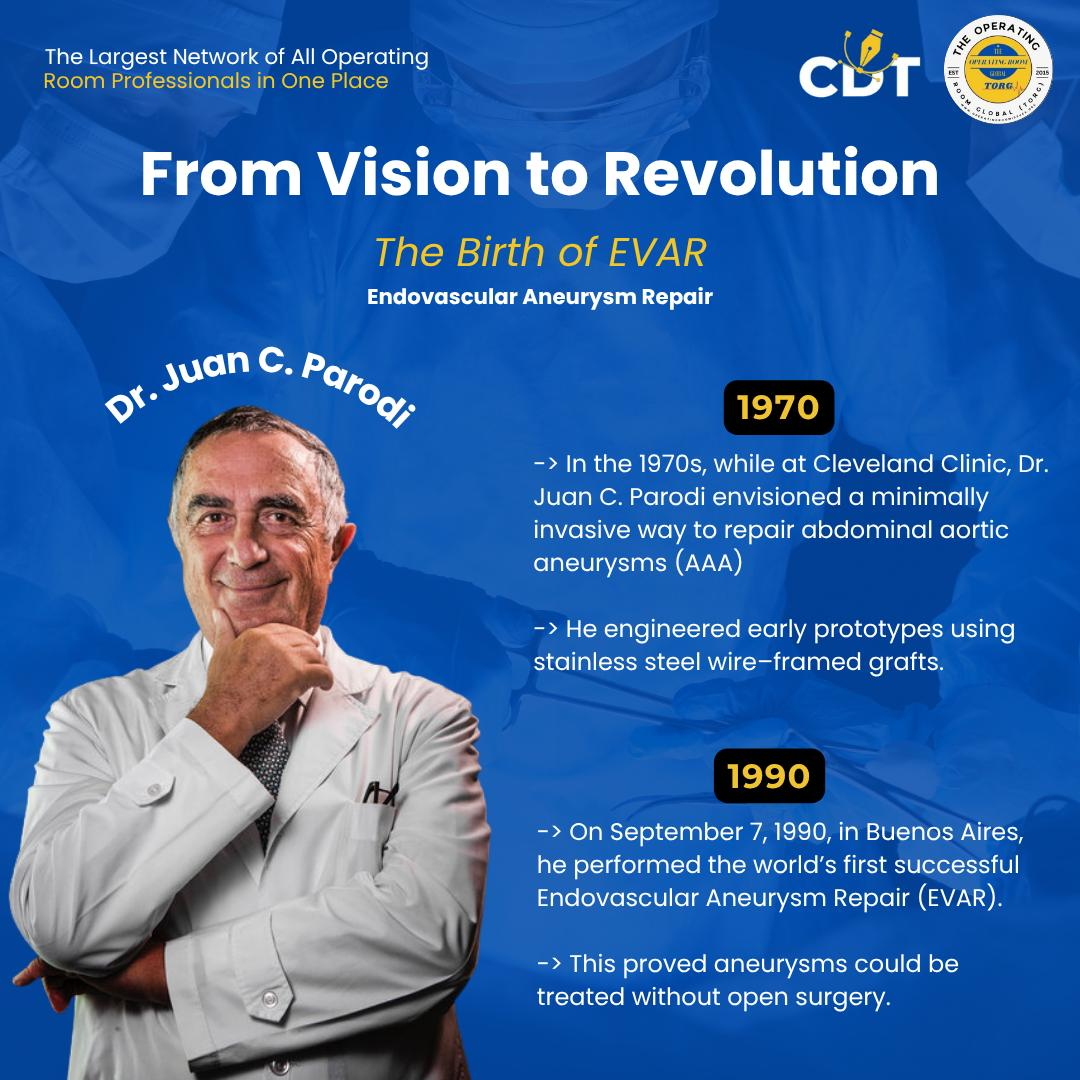
✨ 𝓙𝓾𝓪𝓷 𝐂. 𝐏𝐚𝐫𝐨𝐝𝐢: 𝑻𝒉𝒆 𝑷𝒊𝒐𝒏𝒆𝒆𝒓 𝑾𝒉𝒐 𝑹𝒆𝒗𝒐𝒍𝒖𝒕𝒊𝒐𝒏𝒊𝒛𝐞𝐝 𝓥𝓪𝓼𝓬𝓾𝓵𝓪𝓻 𝓢𝓾𝓻𝓰𝓮𝓻𝔂 ✨
🌟 Introduction
Few surgeons have transformed patient care as profoundly as Dr. Juan C. Parodi. During the 1970s, while training at Cleveland Clinic, he envisioned a minimally invasive approach for abdominal aortic aneurysms (AAAs). His goal was to reduce the risks and recovery time associated with open surgery, laying the foundation for Endovascular Aneurysm Repair (EVAR); A technique that would revolutionize aortic surgery worldwide (Cleveland Clinic, 2019).

🧠 Early Development and Mentorship
Guided by mentors Drs. Alfred Humphries and Edwin Beven, Parodi began engineering prototype grafts in 1976, exploring catheter-based delivery systems to exclude aneurysms from circulation without open surgery. His early experiments used innovative materials such as elastic stainless steel wires (Cleveland Clinic, 2019).
🛠️ First Successful EVAR
In the 1980s, he partnered with Dr. Julio Palmaz to refine stent-graft technology. On September 7, 1990, Dr. Parodi performed the first successful EVAR on a 70-year-old patient in Buenos Aires. This landmark procedure demonstrated that minimally invasive aortic repair could be safe, effective, and life-saving (Parodi et al., 1991).

🌍 Global Impact
EVAR rapidly gained global adoption: by 2019, over 1 million procedures had been performed worldwide, with roughly 80% of AAAs treated via EVAR. Advanced devices, including branched and fenestrated grafts, now allow treatment of complex aortic pathologies, including those in low-resource settings, dramatically improving patient outcomes. (Parodi et al., 1991).
💡 Legacy and Inspiration
Dr. Parodi’s work exemplifies innovation, persistence, and mentorship. His pioneering spirit continues to inspire surgeons worldwide, highlighting how one visionary can reshape a field and save countless lives. (Parodi et al., 1991).
🌍 𝐉𝐨𝐢𝐧 𝐎𝐮𝐫 𝐆𝐥𝐨𝐛𝐚𝐥 𝐂𝐨𝐦𝐦𝐮𝐧𝐢𝐭𝐲!
The Operating Room Global (TORG)
𝑇ℎ𝑒 𝐿𝑎𝑟𝑔𝑒𝑠𝑡 𝑁𝑒𝑡𝑤𝑜𝑟𝑘 𝑜𝑓 𝑎𝑙𝑙 𝑂𝑝𝑒𝑟𝑎𝑡𝑖𝑛𝑔 𝑅𝑜𝑜𝑚 𝑃𝑟𝑜𝑓𝑒𝑠𝑠𝑖𝑜𝑛𝑎𝑙𝑠 𝑖𝑛 𝑂𝑛𝑒 𝑃𝑙𝑎𝑐𝑒!
Learn More:
https://linktr.ee/operatingroomissues